The working principle of an engine (four-stroke theory)


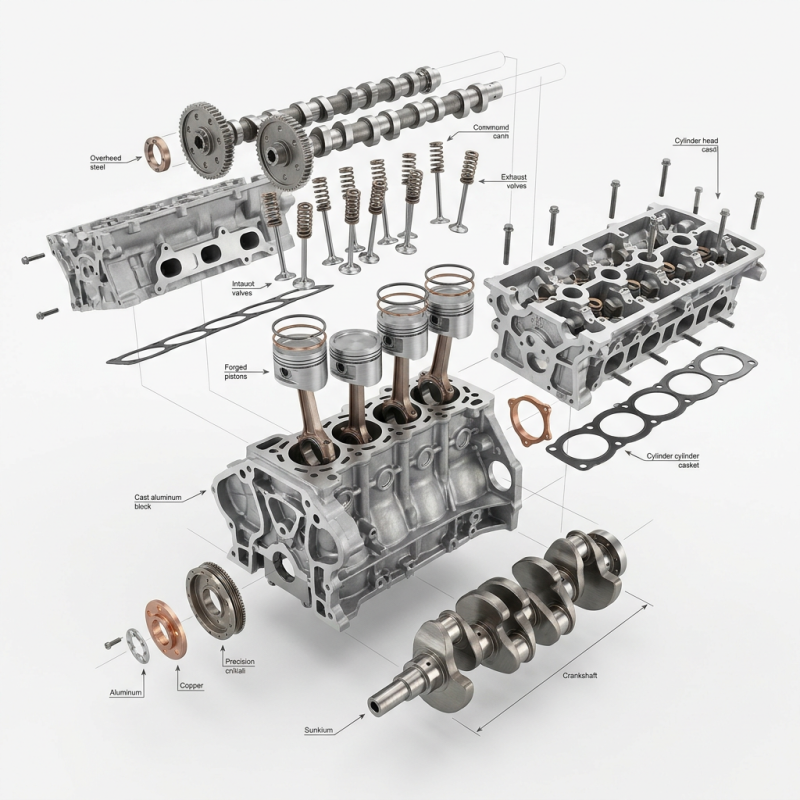
The four-stroke cycle is the physical benchmark for energy conversion in modern internal combustion engines. Its core logic is that within the time span of two crankshaft rotations (720 degrees), the piston’s four reciprocating strokes within the cylinder convert the chemical energy of fuel into mechanical kinetic energy. The entire cycle begins with the “intake stroke,” where the intake valve is open and the exhaust valve is closed. The piston moves from top dead center (TDC) to bottom dead center (BDC), and the rapid expansion of the cylinder’s internal volume creates a negative pressure zone below atmospheric pressure, thus driving air (diesel engines) or an air-fuel mixture (gasoline engines) into the cylinder. Then comes the “compression stroke,” where the intake and exhaust valves are completely closed, and the piston moves in the opposite direction from bottom dead center to top dead center, forcibly compressing the intake gas into the extremely small combustion chamber space. In this physical process, the internal energy of the gas increases dramatically, and the pressure and temperature rapidly rise according to the adiabatic compression law $P_1 V_1^\gamma = P_2 V_2^\gamma$, creating a high-energy physical environment for the subsequent intense combustion.
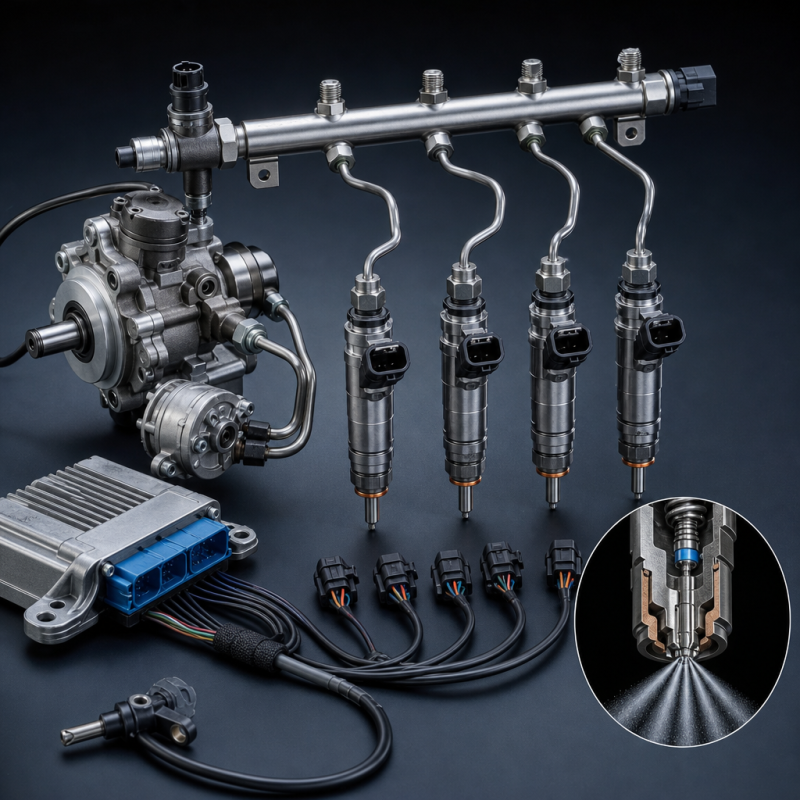
When the piston reaches near top dead center of the compression stroke, the engine enters the most energy-intensive “power stroke” (also known as the expansion stroke) of the cycle. For gasoline engines, the spark plug ignites the air-fuel mixture with an electric spark; for the Perkins diesel engine you previously discussed, the injector atomizes high-pressure diesel fuel directly into the high-temperature air, triggering auto-ignition (compression ignition). This instantaneous chemical reaction produces extremely high-pressure combustion gases. According to F = P × A (pressure multiplied by piston crown area), the enormous thrust is transmitted to the crankshaft via the connecting rod, converting linear motion into rotational torque. This is the only stage in the entire four-stroke cycle that produces positive work. Immediately following, the cycle enters the final “exhaust stroke.” The exhaust valve opens early, and the piston, relying on the inertia stored in the flywheel, moves again from bottom dead center to top dead center, forcibly pushing the combusted exhaust gases into the exhaust manifold. The efficiency of this stage (i.e., “scavenging efficiency”) directly determines the quality of fresh air intake in the next cycle.
In actual mechanical operation, these four strokes are not isolated segments, but rather achieve a seamless physical overlap through complex valve timing. For example, to utilize the inertia of airflow to increase the intake volume, the intake valve typically opens before the end of the exhaust stroke, while the exhaust valve closes completely only after the start of the intake stroke; this phenomenon is known as “valve overlap.” Furthermore, since a four-stroke engine produces effective power only once every two revolutions, the multi-cylinder design, by evenly distributing the power strokes of each cylinder within a 720-degree cycle, greatly smooths out fluctuations in torque output. This thermodynamic Otto cycle (gasoline) or Diesel cycle (diesel), achieved through the reciprocating motion of the piston, remains the mechanical cornerstone of global industrial and transportation power systems.
jianming machiner