Working principle of a two-stroke engine

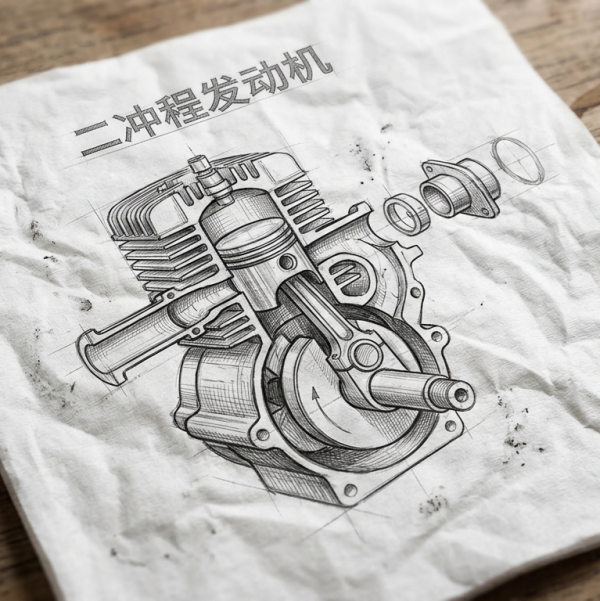
The core appeal of a two-stroke engine in mechanical engineering lies in its extreme power density and streamlined structure. Unlike a four-stroke engine, which manages intake and exhaust through a complex valve train (valve, camshaft, rocker arms, etc.), a two-stroke engine cleverly transforms the piston itself into a high-frequency sliding “distribution valve.” With each revolution of the crankshaft, the engine completes a full power cycle, meaning that at the same engine speed, its ignition frequency is twice that of a four-stroke engine. As the piston moves upward, its top compresses the air-fuel mixture left over from the previous cycle, while the enclosed space formed by the piston bottom and the crankcase creates a vacuum due to the increased volume, drawing in fresh air-fuel mixture from the intake port. When the piston reaches top dead center and triggers combustion, the rapidly expanding combustion gases push the piston downward, at which point the bottom of the piston begins to compress the air-fuel mixture in the crankcase. As the piston reaches the end of its stroke, the exhaust port and scavenging port on the cylinder wall are exposed sequentially. Fresh gas, pressurized in the crankcase, rushes into the cylinder through the scavenging port, using its own inertia to force out any remaining exhaust gas. This design completely eliminates the need for a sophisticated and heavy valve system, giving the engine an unparalleled power-to-weight ratio, making it an ideal power source for logging saws, light off-road motorcycles, and even ultra-large ocean-going freighters.
While two-stroke engines have a significant advantage in power output, the “scavenging loss” during their thermodynamic cycle is a major engineering challenge, directly limiting their fuel economy and environmental performance. Because the exhaust port and scavenging port open simultaneously at a certain moment, this “scavenging” process inevitably results in some unburned fresh air-fuel mixture being directly released into the atmosphere with the exhaust gas, causing physical energy waste and high fuel consumption. Furthermore, to maintain this unique intake logic, the crankcase of a two-stroke engine must participate in scavenging, meaning it cannot store lubricating oil at the bottom like a four-stroke engine. To prevent dry friction in high-frequency mechanical parts, maintenance personnel must mix special lubricating oil into the fuel in a specific ratio. While this “mixed combustion” mode gives the engine the ability to operate stably at any tilt angle (crucial for garden machinery), the large amount of blue smoke and unburned hydrocarbons produced during combustion pose significant challenges to modern stringent emission standards, prompting small two-stroke engines to gradually evolve towards more environmentally friendly electronic direct injection technology.
In higher-end industrial applications, such as two-stroke low-speed diesel engines driving giant cargo ships, engineers have successfully overcome the efficiency shortcomings of traditional models by employing “single-flow scavenging” technology. These engines feature a large electronically controlled exhaust valve on the cylinder head, while the lower part of the cylinder has a ring of scavenging ports. Fresh air enters from the bottom of the cylinder, spiraling upwards and pushing the exhaust gases vertically upwards. This unidirectional scavenging model greatly reduces short-circuit losses of the fresh gas. These giant two-stroke engines typically boast thermal efficiencies exceeding 50% (currently the pinnacle of thermal efficiency for internal combustion engines worldwide) and can directly drive the main propeller at extremely low speeds (usually below 100 RPM), eliminating the need for expensive reduction gearboxes. Whether for the portability sought in miniature garden machinery or the ultimate efficiency pursued in ocean-going power, two-stroke technology, with its unique mechanical topology, occupies an irreplaceable position in the internal combustion engine family, while also posing extremely high engineering requirements for materials science and fluid dynamics simulation.