Diesel engine core technology system


The core technology of a diesel engine is essentially a system that efficiently, stably, and cleanly converts the chemical energy of fuel into mechanical work. It is not a simple juxtaposition of several advanced components, but rather a hierarchical structure of technologies progressing along a causal chain. The innermost layer is combustion process control, which involves delivering the right amount of fuel in the right form to the right location at the right time. This determines the heat release pattern and the upper limits of thermal efficiency, emissions, and noise. The next layer is energy conversion and mechanical structure, involving how the cylinder block, crankshaft, connecting rods, pistons, and valve train maintain geometric precision and fatigue life under extremely high combustion pressures and thermal loads. Further out is heat and flow management, including all heat transfer and flow paths such as cooling, lubrication, intake, and exhaust. The outermost layer is control and diagnostics, which uses sensing, execution, and algorithms to constrain the behavior of the above layers within the design boundaries. Evaluating the technical level of a diesel engine typically involves several quantifiable indicators: effective thermal efficiency, power output per liter and power density, emission limit compliance margin, overhaul life, and total lifespan maintenance costs. Ultimately, the trade-offs in all core technologies must revolve around a balance among these indicators.
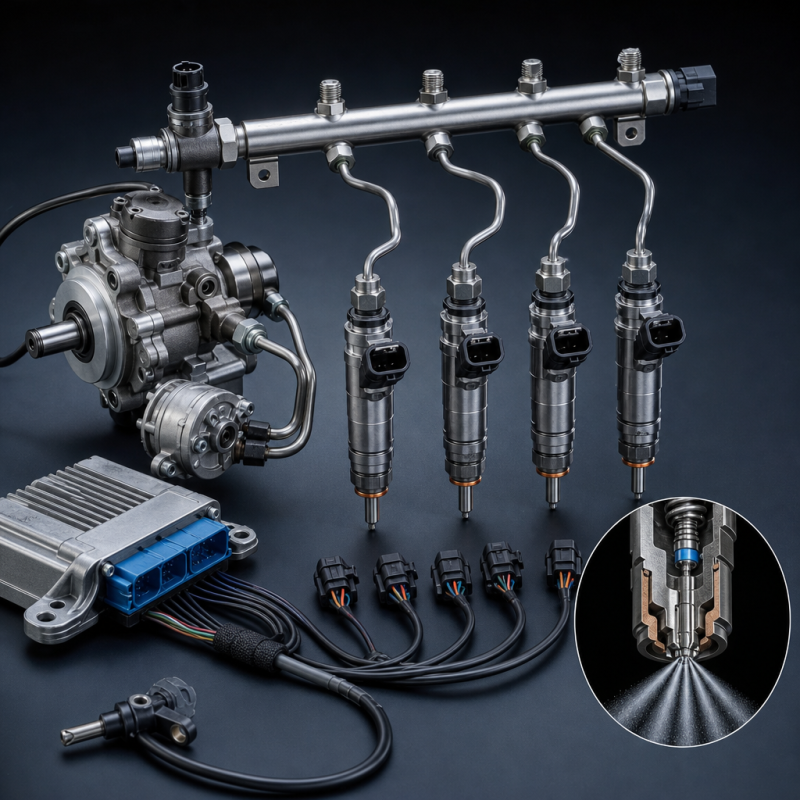
At the core level of combustion control, the main thread of technological evolution is the continuous increase in control precision across the two degrees of freedom: injection and intake. On the injection side, the fixed characteristics of mechanical pumps have evolved into the programmable characteristics of high-pressure common rails. Injection pressures exceeding 2000 bar have significantly improved atomization fineness. Injection patterns can be shaped through layered combinations of pre-injection, main injection, and post-injection, thereby suppressing pressure rise rate while simultaneously addressing carbon dioxide oxidation. On the intake side, variable geometry turbines and two-stage turbocharging resolve the conflict between low-speed response and all-condition turbocharging efficiency. Intercooling further enhances air intake density. Miller cycle and variable valve timing reduce compression negative work by altering the effective compression ratio and expansion ratio. Exhaust gas recirculation suppresses nitrogen oxide formation by diluting oxygen concentration and increasing heat capacity. When these methods are combined to a certain extent, the combustion process may enter the low-temperature combustion range. Homogeneous charge compression ignition (HCCI) and premixed compression ignition (PCCI) technologies attempt to suppress both nitrogen oxides and soot by extending mixing time and reducing local stoichiometry. However, their controllability and operating condition coverage remain major obstacles to engineering implementation. The supporting structural layer technologies are equally crucial: vermicular graphite cast iron cylinder blocks achieve a balance between strength and thermal conductivity; forged steel crankshafts and fracture-resistant connecting rods withstand higher combustion pressures; piston cooling nozzles and internal cooling oil passages control top-land temperatures; four valves and overhead camshafts reduce intake and exhaust resistance; wet cylinder liners facilitate overhaul replacement; and diamond-like carbon coatings, low-tension piston rings, low-viscosity engine oil, and variable displacement oil pumps reduce mechanical losses from a tribological perspective.
While thermal management, aftertreatment, and control calibration are on the periphery of the technical layering, they determine whether the core technologies can realize their theoretical potential under real-world operating conditions. The zoned cooling system implements differentiated flow distribution based on the thermal load differences between the cylinder head nose area, the upper cylinder liner, and the lower engine block. The electronically controlled thermostat and fan incorporate coolant temperature into a closed loop, shortening warm-up time and reducing heat loss under partial load. The aftertreatment chain consists of an oxidation catalyst, a particulate filter, a selective catalytic reduction (SCR) system, and an ammonia escape catalyst connected in series. Its efficiency is highly dependent on the exhaust temperature window and urea injection precision, therefore it must be designed in conjunction with the combustion-side exhaust temperature management. The control layer is the nerve center connecting all technologies. The electronic control unit (ECU) uses signals such as engine speed, load, rail pressure, intake pressure, temperature, and NOx concentration to perform multi-variable coordinated adjustments to injection timing and quantity, boost pressure, exhaust gas recirculation rate, throttle opening, and urea injection quantity. Model-based calibration methods make it possible to perform full-condition optimization on a test bench, while on-board diagnostics and remote data transmission extend control precision from the factory state to the entire life cycle. It is important to emphasize that the value of core technologies is never reflected in leading a single parameter, but rather in the maturity of system integration: increased injection pressure leads to pump power loss and emission fluctuations, increased exhaust gas recirculation rates worsen carbon soot and fuel consumption, and faster turbo response may sacrifice high-speed efficiency. Any enhancement must be offset by the absorption capacity of other components. Therefore, the essence of engineering judgment is to find a long-term stable operating point among power, economy, emissions, and reliability, and to ensure that this operating point remains valid even under wear, carbon buildup, changes in ambient temperature, and fluctuations in fuel quality.
jianming machinery