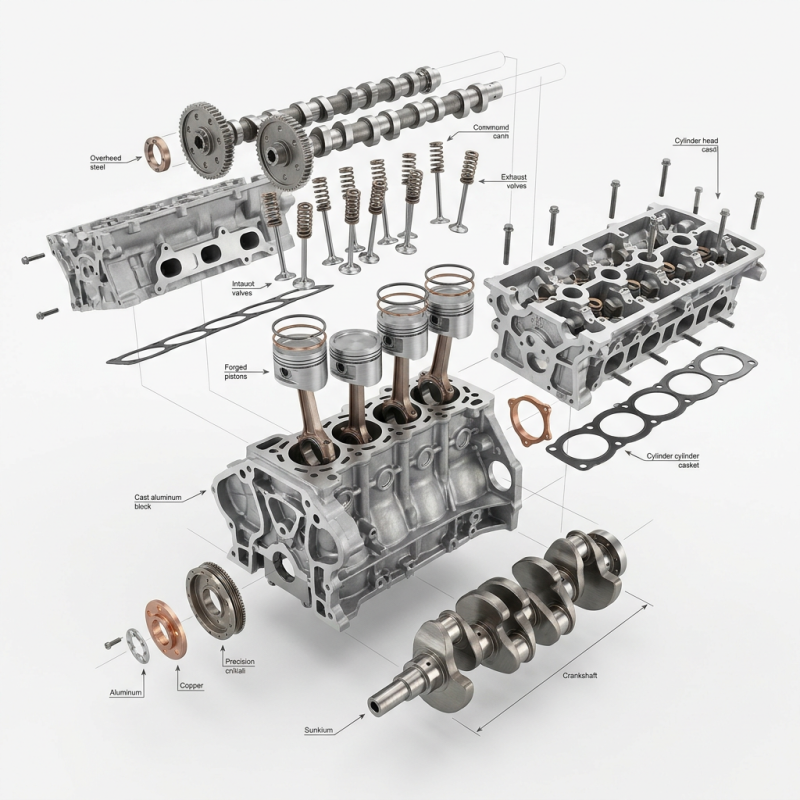
The function of the camshaft in an engine

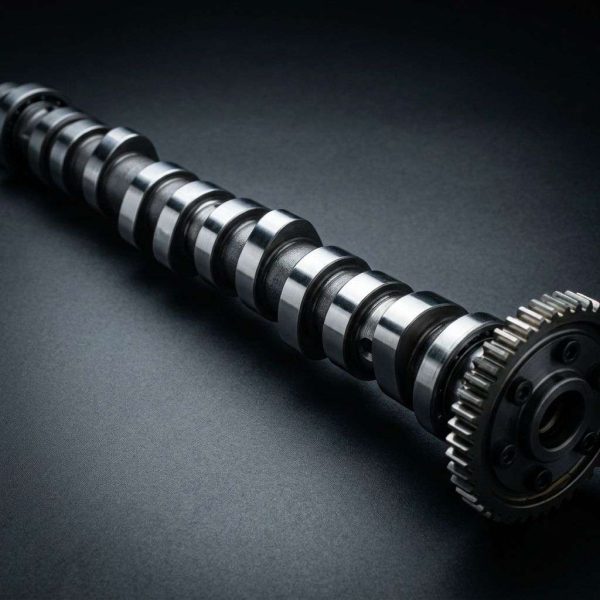
The camshaft acts as the absolute “commander” within an internal combustion engine system; its core function is to orchestrate the opening and closing of intake and exhaust valves through precise timing control, thereby determining the cylinder’s “breathing” efficiency throughout the thermodynamic cycle. Physically, the camshaft consists of a series of uniquely shaped cams; as it rotates—driven by the crankshaft via a timing chain, gears, or a belt—these cam profiles periodically actuate valve lifters, rocker arms, or the valves themselves, forcing the valves to open and return at specific crankshaft angles. The precision of this mechanical actuation directly defines the engine’s “character”: cam lift determines the cross-sectional area of the airflow passage, duration sets the time span for gas exchange, and the cam profile slope controls valve opening acceleration—factors that influence inertial loads and vibration characteristics at high engine speeds. Because the camshaft must maintain exceptional geometric precision amidst high temperatures, high pressures, and constant metal-on-metal friction, the choice of materials and surface heat treatment processes often represents the pinnacle of the engine’s manufacturing quality.
As engines evolve to meet the dual demands of high performance and environmental sustainability, the camshaft’s role has expanded beyond simple opening and closing control; through the integration of Variable Valve Timing (VVT) and Variable Valve Lift (VVL) technologies, it now enables dynamic modulation of the engine’s power output characteristics. At low engine speeds, adjusting the camshaft phase angle optimizes valve overlap, significantly improving fuel economy and reducing emissions; conversely, during high-speed operation requiring robust output, switching to a high-lift cam profile substantially increases intake and exhaust flow velocities, extracting power performance that transcends the limits typically imposed by engine displacement. From early Overhead Valve (OHV) designs to the Double Overhead Camshaft (DOHC) configurations standard in modern high-performance engines, the evolution of the camshaft reflects not only a continuous reduction in reciprocating mass but also a deepening understanding of fluid dynamics. It can be said that camshaft design is not merely a technical challenge involving materials mechanics and mechanical structure; it is an art of balancing physics—specifically, the trade-off between smooth power delivery at low RPMs and explosive performance at high RPMs. It imbues the powertrain—the beating heart within the metal shell—with a rhythmic “breath” and a soul, serving as the crucial cornerstone that determines whether an engine becomes a mediocre unit or a legendary piece of high-performance machinery.
jianming machinery