Structural Technology Analysis of Vertical and Horizontal Engines

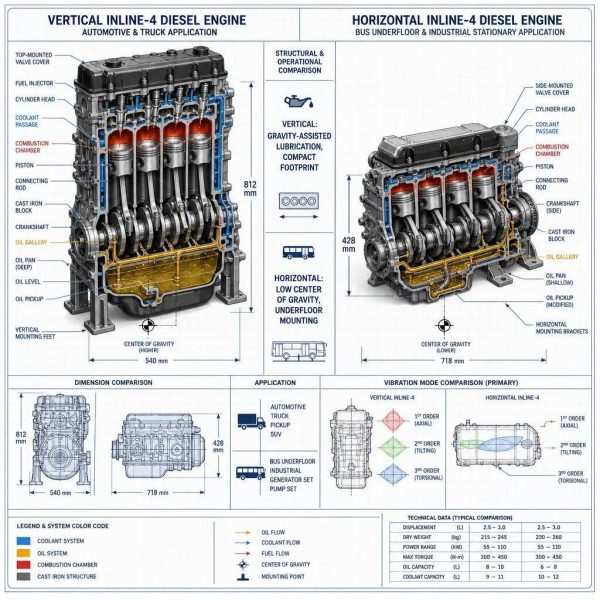
The fundamental difference between vertical and horizontal engines lies in the spatial orientation of the cylinder centerline relative to the ground plane. This seemingly simple geometric difference leads to drastically different mechanical characteristics and adaptation logic in engineering applications. In a vertical engine, the cylinders are arranged vertically upwards, with the piston reciprocating in the direction of gravity. The crankshaft is located at the lower end of the engine block and drives the piston up and down via connecting rods. This structure results in a highly concentrated engine with a significantly reduced footprint, making it dominant in mobile machinery such as excavators, loaders, and commercial vehicles that require ample lateral space in the engine compartment and a high degree of structural integrity. Another major engineering advantage of the vertical cylinder layout is that the piston’s own gravity direction naturally aligns with the thrust direction of the power stroke. The lateral thrust distribution of the piston skirt in the direction perpendicular to the crankshaft centerline is more symmetrical, which helps reduce uneven wear between the piston and cylinder wall. In contrast, a horizontal engine arranges the cylinders horizontally, with the piston reciprocating on a horizontal plane. The crankshaft is perpendicular or parallel to the ground, resulting in an extremely low center of gravity and significantly reduced height. This makes it irreplaceable in scenarios where a lower overall center of gravity is required to improve driving stability. The choice between these two cylinder arrangement configurations not only affects the overall layout of the vehicle or engine, but also directly determines the mixing path of splash lubrication and pressure lubrication, the direction of oil return in the valve mechanism, and the thermal convection distribution of coolant in the cylinder head water jacket. Each of these factors forms the physical basis for the long-term reliability of the engine.
The dynamic differences in the lubrication system are one of the core engineering factors contributing to the divergence in long-term service performance between vertical and horizontal engines. In a vertical engine, the oil naturally flows towards the oil pan under gravity. As the connecting rod big end descends, it can be immersed in the oil pan for effective splashing. Simultaneously, after engine shutdown, the oil in the valve train above the cylinder head flows smoothly back to the crankcase, preventing abnormal oil accumulation and leakage in the valve chambers. In horizontal engines, the horizontal orientation of the cylinders necessitates a stronger oil pump pressure to deliver oil to the entire lower semicircular surface of the piston cylinder liner for splash lubrication. This is because the oil cannot achieve a uniform circumferential coverage using gravity as in vertical engines. This places higher demands on the initial pressure build-up speed of the oil pump and the precise design of the oil passages. More importantly, the bottom cylinder liner of a horizontal engine bears continuous contact pressure from the piston’s own weight over extended periods. During periods of inactivity, the lack of an oil film separating the piston rings from the lower generatrix of the cylinder liner leads to a more significant risk of boundary lubrication issues on the lower cylinder wall upon restarting after prolonged periods of inactivity.
From the perspective of application scenario differentiation and comprehensive techno-economic evaluation, vertical and horizontal engines each constitute an irreplaceable industrial niche. Vertical engines, with their mature manufacturing processes, high parts commonality, and convenient accessibility for routine maintenance, hold a very solid market position in heavy-duty excavators, large generator sets, and long-haul logistics trucks that require high power output. Their top-mounted valve cover and side-mounted components such as the fuel injection pump and turbocharger can be quickly inspected without lifting the engine. Horizontal engines, on the other hand, offer unparalleled chassis integration advantages due to their low profile, forming an irreplaceable professional barrier in low-floor buses, railway track inspection vehicles, and certain special military equipment requiring extremely low engine compartment height.
jianming machinery