An In-Depth Comparison of Cylinder Arrangement Geometry and Structural Integrity: Inline vs. V-Type Engines

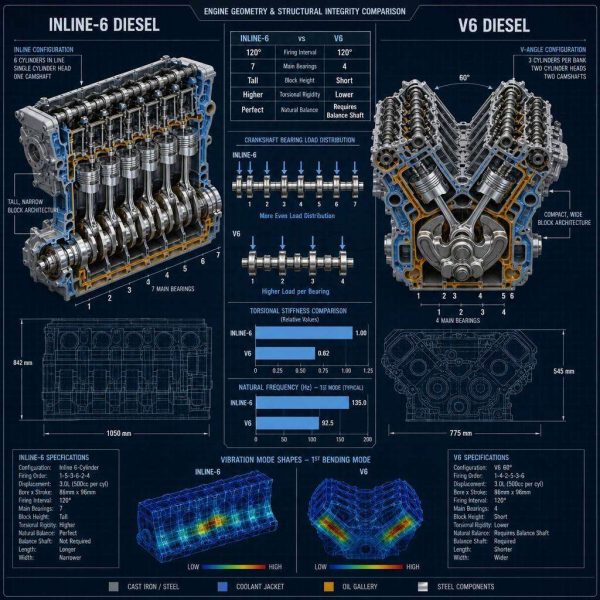
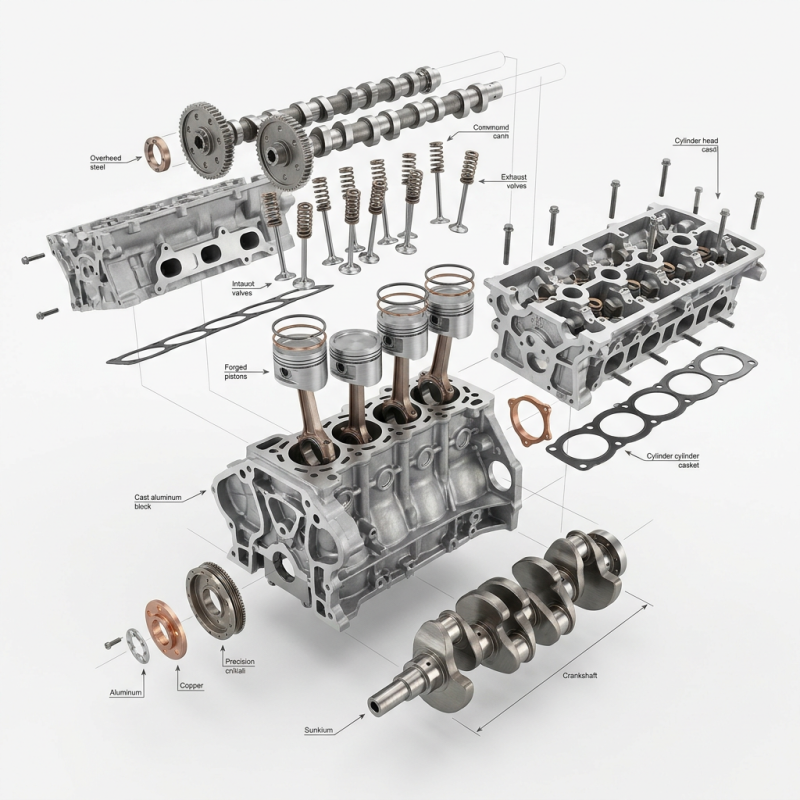
Inline and V-type engines represent the two most classic and widely used cylinder configurations in the internal combustion engine family. The fundamental distinction lies in whether the cylinders are arranged sequentially in a straight line or split into two banks positioned symmetrically on either side of the crankshaft at a specific angle. In inline engines—commonly ranging from three to six cylinders—the cylinders are arranged vertically or at an incline within a single engine block, sharing a common crankshaft and cylinder head. This single-block casting structure yields exceptional lateral rigidity, ensuring minimal deformation of the crankcase under the pressure of combustion. During machining, all cylinder bores can be bored and honed in a single clamping setup; this simplified manufacturing process facilitates consistent cylinder concentricity, providing a solid technical foundation for the micron-level clearances required between piston rings and cylinder liners. In contrast, V-type engines divide the cylinders into two banks angled at 60 or 90 degrees, with each bank featuring its own cylinder head and valvetrain, while the crankshaft drives the pistons in both banks alternately via a more complex crankpin offset design. This configuration reduces the engine’s longitudinal length by nearly half for the same number of cylinders, though it comes at the cost of significantly increased casting complexity, requiring space between the cylinder banks for main oil galleries, coolant passages, and the timing drive mechanism. These architectural differences imply not only disparities in machining costs and assembly processes but also dictate the load distribution and wear patterns of critical moving parts—such as crankshaft main bearings, connecting rod bearings, and timing chains—over the engine’s service life.
Analysis of Dynamic Differences: Vibration Characteristics and Self-Balancing Mechanisms
From the perspective of rotational dynamics and the balancing of reciprocating inertial forces, the inline-six engine boasts near-perfect natural balance. With a cylinder entering the power stroke every 120 degrees of crankshaft rotation, the reciprocating motions of the six pistons internally cancel out both first- and second-order inertial forces, delivering exceptionally smooth power output without the need for complex balance shaft systems. However, inline-four engines cannot naturally balance second-order reciprocating inertial forces in the same way six-cylinder engines do; they require dual balance shafts rotating in the opposite direction at twice the crankshaft speed to counteract the severe vertical vibrations caused by the difference in piston acceleration between top dead center and bottom dead center. The vibration characteristics of V-engines depend heavily on the angle between the cylinder banks: a 90-degree V-engine, when paired with a cross-plane crankshaft, can naturally achieve complete balance of first-order inertial forces—the fundamental physical reason why the vast majority of V8 engines utilize a 90-degree angle. While 60-degree V-engines are more compact in terms of width, they require more precise crankshaft counterweight designs to compensate for inertial moments that are not fully cancelled out. For construction machinery operating in high-vibration environments, engine balance characteristics directly impact the fatigue life of accessory brackets, the contact reliability of electrical connectors, and operator fatigue levels. When matching crankshaft, flywheel, and vibration damper assemblies for overhaul projects, Jianming Machinery always prioritizes the engine’s original balance design as a core criterion for precision selection; any counterweight imbalance would be transmitted through the main bearings to the entire powertrain and even the chassis, accelerating fatigue failure in all connecting components.
Spatial Compatibility and Systematic Differentiation in Industrial Applications
Amidst the deep specialization of industrial applications, inline engines and V-engines have each established irreplaceable technical niches. Characterized by a narrow width but relatively greater height and length, inline engines are naturally suited for small-to-medium excavators, loaders, and commercial road vehicles where lateral engine compartment space is at a premium. Their layout—featuring a single cylinder head and intake/exhaust manifolds on one side—facilitates convenient routine maintenance, allowing technicians to adjust valve clearances and remove or install fuel injectors without needing to work on both sides of the engine. The inline configuration is also more favorable for turbocharger plumbing; the exhaust manifold can extend in a straight line along the side of the cylinder block directly to the turbocharger turbine inlet, resulting in shorter piping, fewer bends, and minimized exhaust energy loss. V-configuration engines dominate the sectors of large mining dump trucks, high-speed marine yachts, and high-end, large-displacement passenger vehicles, thanks to their significantly reduced longitudinal length and lower center of gravity. Arranging eight or twelve cylinders in a V-configuration allows for a crankshaft length comparable to that of an inline four-cylinder engine, thereby eliminating the risk of crankshaft fracture caused by torsional vibrations at high speeds. However, the V-layout comes at a cost: the dual-cylinder-head design necessitates two sets of valvetrains, two exhaust manifolds, and a more complex dual-circuit cooling system. These factors not only increase maintenance labor hours and the variety of required spare parts but also raise manufacturing costs and the technical complexity of troubleshooting.
Economic Perspectives: Lifecycle Operating Costs and Spare Parts Interchangeability
When viewed through the economic lens of lifecycle operating costs and spare parts interchangeability, the differences between inline and V-configuration engines translate into vastly different maintenance budgets and expected downtime for end-users. Because inline engines feature a single cylinder head, a single camshaft, and a single set of intake and exhaust manifolds, the variety and quantity of seals, fasteners, and valvetrain components required for overhauls are far lower than those for V-configuration engines. Furthermore, the market availability of compatible spare parts is greater, offering significant advantages in procurement lead times and pricing. For heavy equipment rental companies operating on a large scale with widely distributed fleets, the lower maintenance complexity of inline engines translates to shorter turnaround times for shop inspections and higher equipment utilization rates. Although V-configuration engines are at a disadvantage regarding component costs and maintenance labor, their unparalleled power density and compactness deliver overall system efficiency gains that, over the long term, offset the higher maintenance expenses.
jianming machinery