The Operating Principle of the Crankshaft


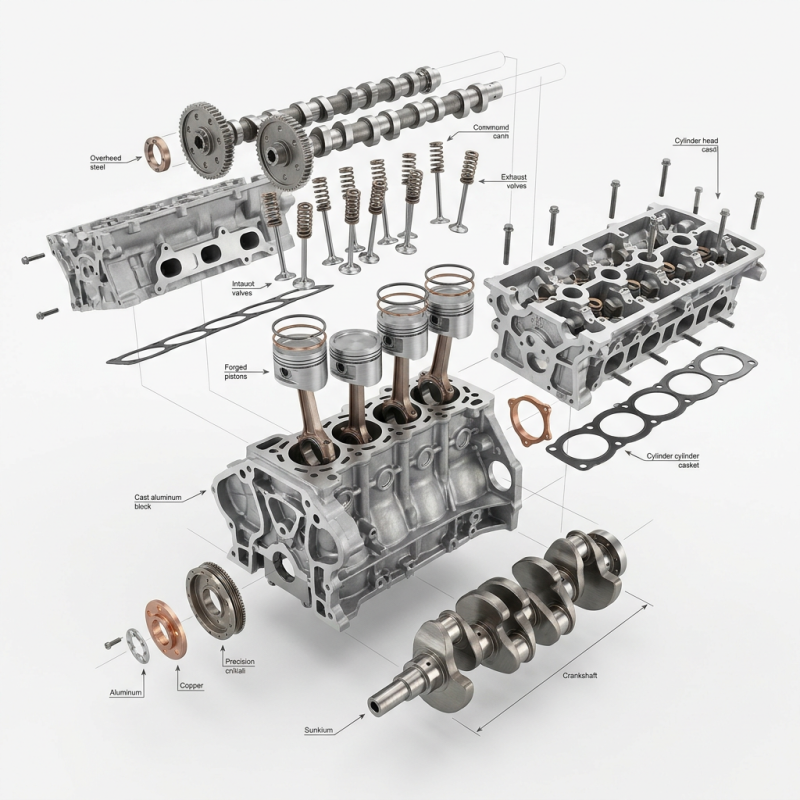
As the central hub for power collection and output within an internal combustion engine, the crankshaft operates based on a fundamental kinematic process: the conversion of the piston’s reciprocating motion into rotational motion—a mechanism known in engineering as the “crank-connecting rod mechanism.” Through a series of meticulously designed eccentric geometric structures, the crankshaft transforms the linear impact forces generated by the pistons—occurring at rates of up to several thousand times per minute within the cylinders—into continuous, smooth rotational torque, thereby driving the operation of the machinery.
Within this physical transformation process, the crankshaft’s operation can be deconstructed into three key dynamic aspects. The first is the leverage amplification effect resulting from the eccentric offset: one end of the connecting rod is linked to the piston via the piston pin, while the other end connects to the crankshaft via the crankpin (connecting rod journal). When the rapidly expanding air-fuel mixture within the combustion chamber drives the piston downward, the connecting rod transmits this immense linear thrust to the crankshaft’s eccentric crankpin. Because of the eccentric distance—the offset—between the crankshaft’s axis of rotation (the main journal) and the crankpin, the thrust from the connecting rod generates a torque; the magnitude of this torque is determined by the length of the eccentric offset and the angle at which the force is applied. This constitutes the physical explanation for why long-stroke engines are capable of generating massive torque at low RPMs: a longer crank arm provides a greater lever arm, thereby facilitating a stronger output torque.
The second aspect involves the precise interplay between inertia compensation and dynamic balancing. In three- or four-cylinder engines, where pistons are typically arranged in a linear configuration, the reciprocating mass generates substantial inertial forces and moments. If left unchecked, these forces would cause the engine to vibrate violently—potentially even leading to structural self-destruction—during operation. Consequently, the crankshaft’s design incorporates not only the crankpins required for connecting the rods but also integrates precisely calculated counterweights. Positioned on the side opposite the crankpins, these counterweights utilize centrifugal force to counteract the inertial forces generated by the reciprocating motion of the pistons and connecting rods, thereby enabling the crankshaft to maintain exceptional stability of its center of gravity even while rotating at high speeds. Furthermore, the crankshaft’s operation relies upon an exceptionally precise hydrodynamic lubrication system. At the main bearings—located between the crankshaft and the engine block’s support saddles—the oil pump maintains a dynamic oil film with a thickness measuring merely a few microns. Under high-speed operation, the crankshaft effectively floats atop a thin film of high-pressure oil; this “zero-contact” physical state completely eliminates metal-to-metal dry friction, thereby ensuring that the crankshaft—even while enduring explosive pressures measured in tons—can achieve a service life spanning tens of thousands of hours.
Finally, the crankshaft’s rotation is strictly synchronized with the valve timing via the timing system, thereby establishing a closed-loop control mechanism for the entire energy conversion process—from input to output. The gear or pulley located at the front of the crankshaft serves a dual function: it connects to the camshaft, thereby dictating the precise timing of valve actuation, and it links to the flywheel—a critical component. During crankshaft operation, the flywheel acts as a “power accumulator”; leveraging its substantial rotational inertia, it absorbs the sudden, massive shock forces generated during the power stroke and releases them smoothly, thereby bridging the power gaps that occur between the non-power strokes (intake, compression, and exhaust). It is precisely through this intricate lever system—which transforms linear explosive forces into smooth rotational torque—supplemented by the dynamic support provided by precision counterweights and the aforementioned suspended oil film, that the crankshaft is able to efficiently and enduringly transmit the chemical energy generated by combustion to the downstream drive wheels or load devices, even under the harsh, high-temperature, and high-pressure operating conditions found within the engine.