The Core Value of Diesel Engine Filter Systems

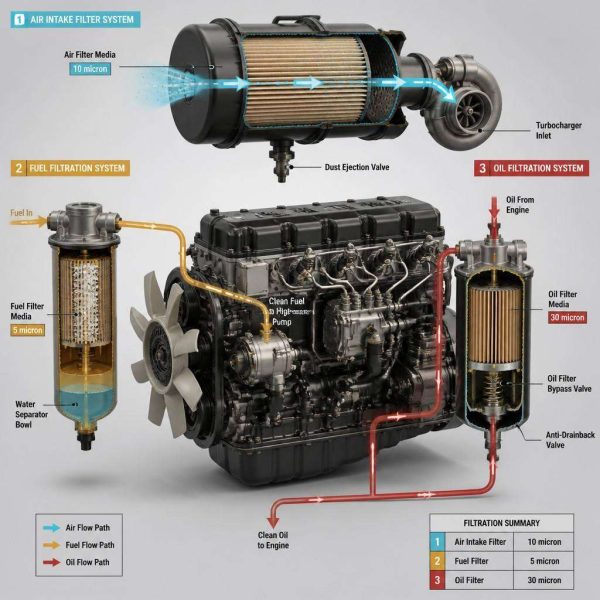
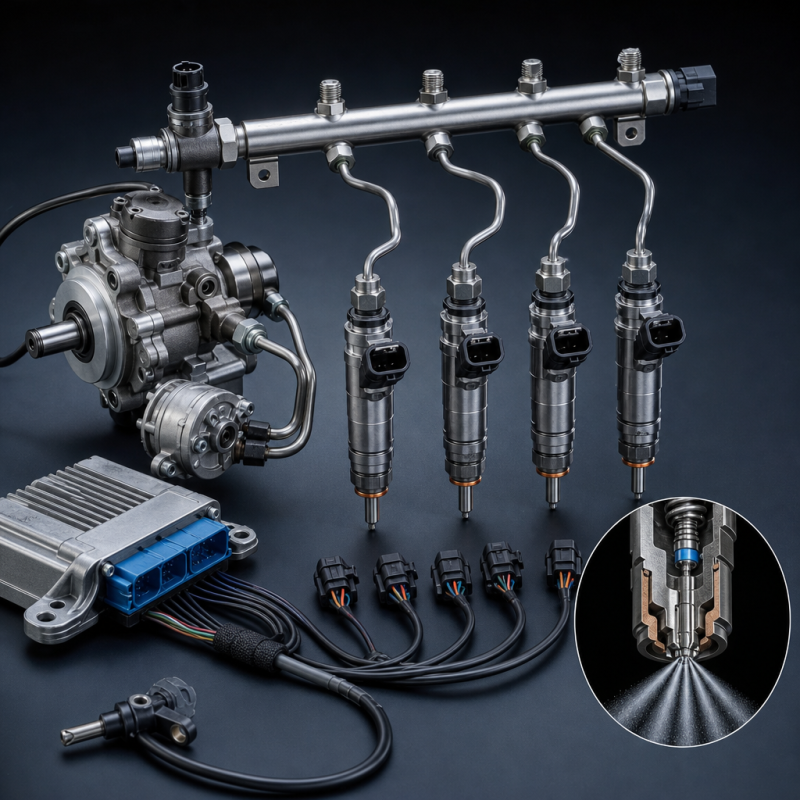
The filtration system of a diesel engine serves as the machine’s “immune system.” Through the coordinated operation of three filtration circuits—fuel, engine oil, and air—it establishes an impenetrable defense against contamination for the engine’s three core functions: high-pressure injection, friction lubrication, and combustion air intake. Within the fuel filtration circuit, the fuel-water separator and the fine fuel filter perform the dual task of trapping impurities and separating water. During storage and transport, diesel fuel inevitably becomes contaminated with sand, rust particles, and condensed moisture; if these contaminants were to enter the high-pressure common-rail system unfiltered, they would cause irreversible, catastrophic damage to precision mating components within minutes. The clearances between the injector needle valve and its seat, as well as within the plunger assembly of the high-pressure common-rail system, are measured in microns. A single hard particle exceeding the filter’s rating acts like sandpaper, scoring the sealing surfaces of these precision components; this leads to a drop in injection pressure and degraded atomization quality, ultimately resulting in incomplete combustion and a loss of power. The filtration precision and contaminant-holding capacity of the fuel filter must precisely match the technical specifications of the engine’s injection system. While using low-precision, cheap filter elements may appear to save on consumable costs, it actually exposes precision injectors—valued at tens of thousands of yuan—to a high risk of wear. This “penny-wise, pound-foolish” approach to maintenance is one of the most common root causes of premature diesel engine failure.
The coordinated protection provided by the engine oil and air filtration circuits safeguards the engine’s friction lubrication system and combustion air intake system, respectively; failures in these areas are similarly insidious yet fatal. Engine oil circulates in a high-temperature, high-pressure environment, carrying metal wear debris washed from the friction surfaces of bearing shells, piston rings, and camshafts, as well as combustion by-products and oxidized gums. The oil filter continuously removes these particles from the lubrication circuit using deep-filtration media, thereby maintaining the oil’s cleanliness throughout the service interval. If an oil filter becomes clogged prematurely, causing the bypass valve to open, unfiltered oil carrying high concentrations of abrasive particles flows directly over friction surfaces; this can cause groove-like wear on precision components—such as crankshaft bearings and camshaft lobes—in a very short time. Meanwhile, as the first line of defense for the engine’s intake system, the air filter’s efficiency directly determines the cleanliness of the air entering the combustion chamber. In extremely dusty environments like mines or quarries, if the air filter is damaged or its seal fails, fine sand particles can enter the cylinder during the intake stroke. These particles create an abrasive “sandpaper effect” against the piston rings and cylinder liners, resulting in scoring marks on the cylinder wall that run perpendicular to the crankshaft. Jianming Machinery notes that the turbocharger—a precision component featuring high-speed floating bearings—is particularly sensitive to particles in the intake air; any impact from foreign objects can deform the compressor impeller edges and disrupt dynamic balance. Therefore, the integrity and sealing performance of the air filter constitute the first and most critical line of defense for protecting the turbocharging system and the entire intake chain.
From the perspective of filtration system maintenance strategies and total lifecycle economics, the periodic replacement of filter elements is not merely an expenditure on consumables; it is a strategic investment that significantly enhances the machine’s service life and reliability at a minimal cost. Modern diesel engine filtration systems have evolved from simple physical barriers into intelligent protection networks that integrate high-efficiency filtration media, water-fuel separation, and sensor monitoring. Some models utilize differential pressure sensors to monitor filter clogging levels in real-time and alert operators via the dashboard when maintenance is required. This condition-based maintenance approach allows the timing of filter replacements to be precisely aligned with actual contamination loads, thereby avoiding the waste associated with over-maintenance and the risks linked to under-maintenance.
jianming machinery