Technical Analysis of Gasoline and Diesel Engines

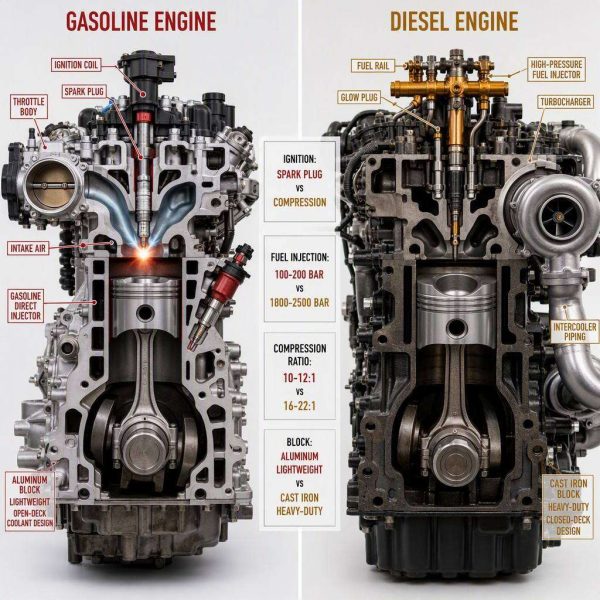
Although gasoline and diesel engines both belong to the internal combustion engine family, their fundamental differences in ignition methods and combustion logic directly shape their vastly different performance in terms of power characteristics, fuel economy, and maintenance costs. Gasoline engines use spark plug ignition, igniting the premixed gasoline-air mixture with an electric spark at the end of the compression stroke. This process requires extremely precise control of the air-fuel ratio, thus gasoline engines typically require complex ignition timing systems and oxygen sensor closed-loop control. Thanks to their lower compression ratio and lighter reciprocating moving parts, gasoline engines have a much higher upper speed limit than diesel engines, enabling them to output a smooth and linear power curve at high speeds. Their smoothness and quietness are also superior, giving them a dominant position in the passenger car market where driving comfort and rapid response are paramount. In contrast, diesel engines rely on compression ratios exceeding 15:1 to raise the air temperature above the diesel’s auto-ignition point for compression ignition. This combustion method gives diesel engines higher thermal efficiency and lower fuel consumption, while their long stroke design provides abundant low-speed torque. The difference between these two combustion logics is not only reflected in the power output curve, but also determines the fundamental differences in the overall engine’s structural strength, material selection, and thermal management strategies. Diesel engines must use a heavier engine block and reinforced moving parts to withstand higher combustion pressures, while gasoline engines extract energy from every drop of fuel through more precise ignition and injection control.
From a long-term perspective of fuel economy and operating costs, diesel engines show a significant advantage in economic efficiency under heavy loads and long-term operating conditions, while gasoline engines exhibit higher overall efficiency in light loads and short-distance scenarios. The higher energy density of diesel fuel and the wider efficient operating range of diesel engines mean that diesel vehicles typically consume about 20% to 30% less fuel than gasoline vehicles of the same displacement. For heavy-duty trucks, construction machinery, and ships with extremely long annual mileage, this difference in fuel costs accumulates into a considerable expense over several years of operation. However, the technical challenges and economic burdens of diesel engine emissions after-treatment are equally significant. The nitrogen oxides and particulate matter produced during combustion must be purified using selective catalytic reduction systems and particulate filters. These complex and expensive after-treatment devices not only increase the initial purchase cost of the entire engine but also incur ongoing costs for urea consumption, filter regeneration, and regular cleaning during long-term use. In contrast, gasoline engines, with their three-way catalytic converters, achieve extremely low harmful emissions. Their emission systems are simple in structure and have low maintenance costs. Furthermore, gasoline engines offer superior emission control and noise performance during cold starts compared to diesel engines. This makes gasoline power irreplaceable in urban environments and light-duty applications where comfort is a primary concern.
From the perspective of matching power characteristics with usage scenarios, gasoline and diesel engines each have their strengths. The essence of selection lies in precisely coupling power characteristics with operational requirements. Gasoline engines’ high-speed power output and smooth operation make them an ideal choice for passenger cars, light trucks, and urban delivery vehicles that require a high level of driving experience; while diesel engines’ low-speed high torque and high fuel efficiency give them an absolute advantage in heavy industrial scenarios that require continuous high torque output, such as heavy-duty climbing, mining, farmland cultivation, and emergency power supply.
jianming machinery