Difference between two-stroke and four-stroke engines


From the perspective of the physical essence of thermodynamic cycles, the core difference between two-stroke and four-stroke engines lies in the crankshaft angle and piston stroke required to complete a full “power cycle.” Four-stroke engines (such as the familiar Perkins 400 series) follow the strict division of labor of the Otto or Diesel cycles. The piston must reciprocate four times within the cylinder, and the crankshaft must rotate twice (720 degrees) to sequentially complete intake, compression, power, and exhaust. This design achieves complete functional isolation, ensuring almost no cross-contamination between fresh air and exhaust gases, thus significantly improving fuel thermal efficiency and emission quality. In contrast, two-stroke engines pursue extreme power frequency. They cleverly overlap the intake and exhaust processes through changes in piston position, allowing power to be generated once for every two piston reciprocations and one crankshaft rotation (360 degrees). This means that at the same engine speed, the ignition frequency of a two-stroke engine is twice that of a four-stroke engine. Therefore, it can achieve a higher thrust-to-weight ratio with a smaller displacement, which is why logging saws or large ocean-going vessels often prioritize two-stroke architectures when pursuing power per unit volume.
Evolution of Mechanical Structure and Valve Train Logic
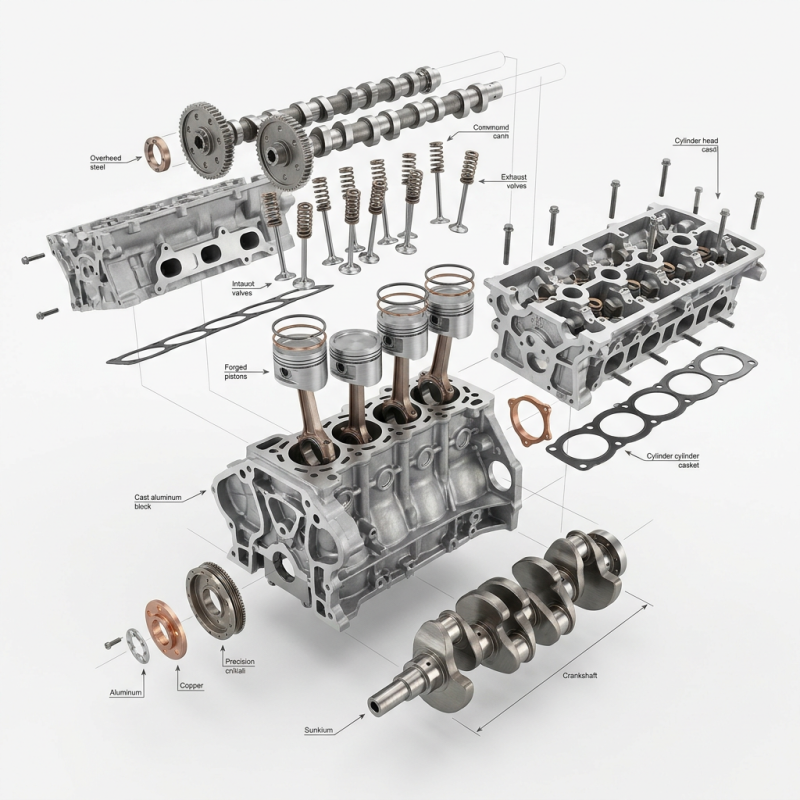
Mechanically, a four-stroke engine relies on a precise and heavy valve train mechanism, including the camshaft, tappets, rocker arms, and overhead valves. This system controls the “breathing” of the cylinders like a precise clock. While this complex structure increases manufacturing and maintenance costs, it gives the engine excellent valve timing control capabilities, allowing for precise adjustment of valve opening times based on engine speed, thus maintaining high torque output across a wide speed range. A typical two-stroke engine, on the other hand, embodies the ultimate in “subtraction engineering,” completely eliminating the valve mechanism and instead directly creating intake, scavenging, and exhaust ports on the cylinder wall. The piston itself is both a power output component and acts as a “valve” controlling the opening and closing of the ports. This valveless design not only significantly reduces the overall weight of the engine but also eliminates the physical risks of valve spring failure or valve impact with the piston at high speeds, making its structure exceptionally simple and durable, enabling stable operation in harsh outdoor or high-vibration environments.
Lubrication System and Energy Conversion Losses
The difference in lubrication methods is another key physical factor determining the application boundaries of these two types of engines. Four-stroke engines have an independent lubrication system; the engine oil is stored in the oil pan at the bottom and is forcibly delivered to the crankshaft, bearings, and cylinder head friction pairs by an oil pump. The oil is physically isolated from the combustion chamber, ensuring long-term oil circulation and very clean combustion. However, in traditional two-stroke engines (especially small gasoline engines), the crankcase participates in the intake compression process and cannot store flowing oil. Therefore, the lubricating oil must be mixed with the fuel in a specific ratio to participate in combustion. This “mixed combustion” inevitably results in blue smoke in the exhaust and produces more hydrocarbon emissions. In addition, during the scavenging phase of a two-stroke engine, the fresh air-fuel mixture and exhaust gas coexist and mix briefly, resulting in some unburned fuel being discharged directly with the exhaust gas. This is thermodynamically known as “scavenging loss,” which is also the main physical reason why the fuel economy of a two-stroke engine is usually inferior to that of a four-stroke engine.