Comparison of Efficiency Between Diesel and Gasoline Engines


The efficiency disparity between diesel and gasoline engines stems from differences in the compression and expansion ratios of their respective thermodynamic cycles; this theoretical distinction forms the physical basis for the diesel engine’s efficiency advantage. Diesel engines utilize compression ignition and are not constrained by the risk of air-fuel mixture knocking, allowing for compression ratios ranging from 15:1 to over 20:1. In contrast, gasoline engines are limited by knocking and ignition stability, typically maintaining compression ratios between 10:1 and 12:1. In an ideal cycle, thermal efficiency increases with the compression ratio because a higher ratio implies a greater expansion ratio; the high-temperature combustion gases can perform more work during expansion, converting more heat into mechanical energy rather than losing it through the exhaust. Higher compression ratios also raise the temperature at the end of the compression stroke, facilitating a more complete release of the fuel’s chemical energy. This efficiency gap—determined by cycle parameters—can theoretically exceed ten percentage points; it is the fundamental source of the diesel engine’s efficiency advantage and represents a structural divide that gasoline engines cannot fully bridge, regardless of how ignition and injection strategies are optimized.
Regarding actual fuel consumption rates, the diesel engine’s advantage is also evident in how its unique operating method avoids pumping losses. Gasoline engines control load by regulating intake air volume via a throttle valve; at partial loads, the partially closed throttle creates a vacuum in the intake manifold. The piston must overcome this negative pressure while drawing in air, resulting in “pumping losses”—a factor that accounts for 10% to 20% of total energy consumption during idling and light-load conditions. Diesel engines, however, employ a quality-regulation approach, adjusting output power by varying the fuel injection quantity rather than restricting intake air. The intake passage remains unobstructed, fundamentally eliminating throttle-induced pumping losses—a key reason why diesel engines demonstrate a more pronounced efficiency advantage under partial-load conditions. Furthermore, diesel engines can operate stably under lean-burn conditions with a high excess-air coefficient, resulting in more complete combustion; gasoline engines, conversely, are constrained by the requirements of the three-way catalytic converter near the stoichiometric air-fuel ratio, preventing the excess-air coefficient from being freely increased—a factor that imposes a limit on their efficiency.
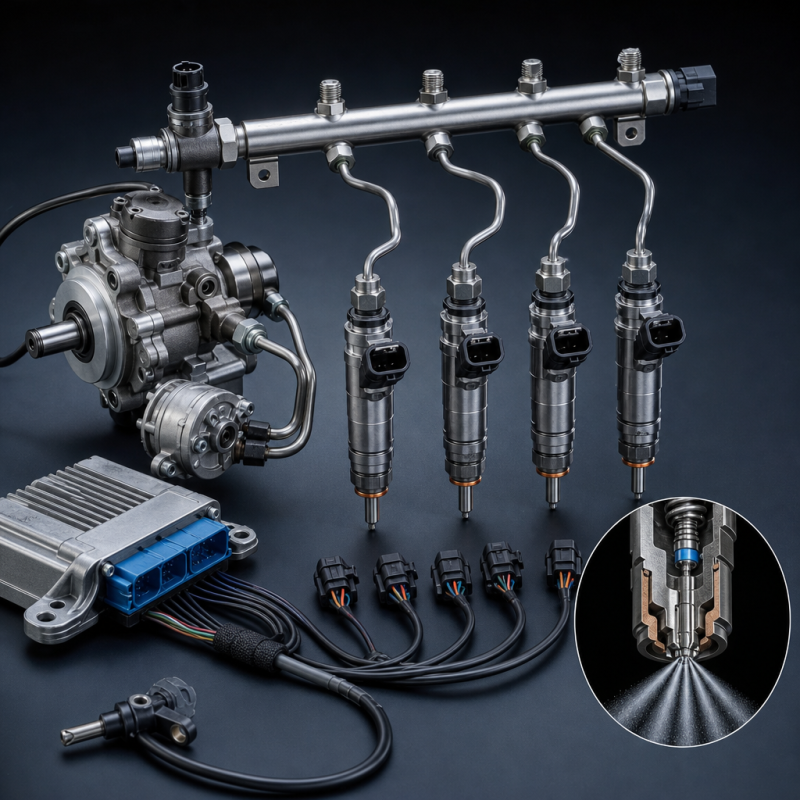
From the ultimate perspective of modern technological evolution and efficiency limits, the efficiency gap between these two types of engines is steadily narrowing due to new technologies, yet the boundaries of their respective applications remain distinct. Through the synergistic optimization of high-pressure common-rail systems, variable-geometry turbochargers, and high-efficiency after-treatment systems, modern diesel engines generally achieve effective thermal efficiencies exceeding 40%–45%, with peak brake thermal efficiencies in heavy-duty commercial vehicle diesels even surpassing 50%. Meanwhile, gasoline engines—leveraging the combined application of technologies such as direct injection, variable compression ratios, the Miller cycle, and advanced exhaust gas recirculation—have raised their effective thermal efficiency to around 40%, approaching the theoretical limit for conventional gasoline engines. In hybrid architectures, gasoline engines can operate consistently within their high-efficiency ranges and recover braking energy, partially compensating for their inherent efficiency limitations; however, under operating conditions requiring sustained high-power output, diesel engines retain a clear efficiency advantage. The practical significance of this efficiency comparison lies in the fact that for heavy-duty equipment with high annual operating hours, the fuel cost savings derived from diesel efficiency accumulate into substantial sums over the vehicle’s lifecycle; conversely, in passenger vehicle scenarios characterized by variable operating conditions and lighter loads, the efficiency disadvantage of gasoline engines can be partially offset by hybrid technology and lightweighting measures. Understanding the mechanisms behind the efficiency differences between these two cycles—specifically regarding compression ratios, pumping losses, and combustion modes—provides the theoretical foundation for evaluating the economic viability and suitability of different powertrain solutions.