Engine speed operating condition analysis

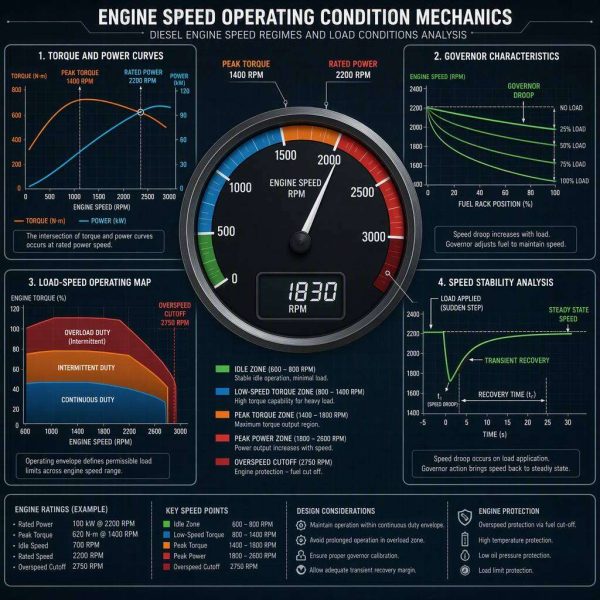
Engine speed directly determines the number of work cycles completed per unit time, thus fundamentally shaping the operating characteristics of power output, fuel consumption, and mechanical wear. In terms of power output, engine torque and power exhibit distinctly different patterns with engine speed: the torque curve typically peaks in the low-to-mid-range speeds because the intake airflow velocity and combustion chamber vortex intensity are optimally matched, resulting in the highest charging efficiency; while power, as the product of torque and speed, continuously increases with speed until it exceeds the flow capacity of the intake and exhaust systems, at which point it begins to decline. This means that in conditions requiring overcoming significant resistance, such as heavy-load starts and hill climbs, maintaining operation in the low-to-mid-range high torque range allows for maximum driving force output with minimal fuel consumption, while pursuing maximum speed or rapid acceleration necessitates higher speeds to obtain peak power. For turbocharged diesel engines, the turbocharger relies on sufficient exhaust energy to build pressure; therefore, its torque plateau typically forms and remains broad in the mid-range speeds. This “low-speed, high-torque” characteristic is the root cause of the ability of construction machinery to dig and load smoothly at low speeds without easily stalling.
In terms of fuel economy and combustion quality, deviations in engine speed significantly impact thermal efficiency through a dual mechanism of charging efficiency and pumping losses. When an engine operates at excessively low speeds and is forced to output heavy loads, insufficient intake airflow weakens the in-cylinder swirl intensity, deteriorates fuel atomization and mixing quality, and leads to incomplete combustion, resulting in black smoke emissions and soaring fuel consumption. Conversely, when an engine operates for extended periods in excessively high speed ranges, the high-speed reciprocating motion of the piston drastically increases intake and exhaust resistance, significantly raising pumping losses and frictional power consumption, similarly leading to decreased thermal efficiency. Modern diesel engines use electronic control systems to calibrate an economical speed range, within which the universal characteristic curve exhibits the lowest fuel consumption rate. Automatic shifting logic and cruise control systems in construction machinery continuously anchor the engine speed within this efficient window, achieving the optimal balance between power and economy. Jianming Machinery has observed in its spare parts selection practice that engines that operate under overload conditions at non-economical speeds for extended periods often exhibit typical carbon deposits and overheating erosion marks on the piston tops and fuel injector tips—the most direct physical evidence of combustion temperatures deviating from the design range.
From a long-term perspective of mechanical wear and life management, the operating mode of engine speed directly determines the cumulative fatigue damage rate of various engine components. The inertial force of reciprocating moving parts such as pistons, connecting rods, and crankshafts is proportional to the square of the engine speed. This means that increasing the engine speed by 10% from its rated value will increase the dynamic load on its moving parts by more than 20%, significantly increasing the load rate of the bearing oil film, the alternating stress of the connecting rod bolts, and the tension fluctuation of the timing chain. Long-term high-speed operation will also accelerate the high-frequency fatigue of valve springs and the wear of turbocharger bearings, while long-term low-speed heavy-load operation will keep the piston rings and cylinder liners in a state of boundary lubrication for a long time. Both will shorten the engine overhaul interval through different failure modes. Therefore, in engineering practice, by reasonably selecting the gear and operating speed to keep the engine running within the design speed range, it is a more effective way to extend the engine’s life than any high-end lubricating oil. Meanwhile, immediately running at high speed after a cold start or failing to allow sufficient idling for cooling before shutdown can both cause damage far exceeding normal wear rates due to the engine oil not yet having established a complete oil film or excessively high turbine bearing temperatures. This operational-level awareness of speed management is the fundamental guarantee for maintaining stable performance throughout the entire life cycle of every engine.
For generator sets with multiple speed ranges, speed stability directly determines the accuracy of output voltage and frequency. Engines operating at constant speed use precision speed governors to control speed fluctuations within a minimal range, ensuring the synchronization quality of grid-connected power generation. For marine propulsion and construction machinery, speed control during variable-speed operation requires real-time balancing between power demand and fuel economy. Understanding the triple impact of speed on power, fuel consumption, and wear is the fundamental prerequisite for scientifically operating and maintaining engines and achieving optimal life-cycle costs.
jianming machinery