Analysis of Diesel Engine Dynamics System


The dynamic characteristics of a diesel engine are rooted in the dynamic coupling between the periodic inertial forces generated by reciprocating components and the combustion and explosion pressures. The firing order design of a multi-cylinder engine is a core engineering approach for managing this dynamic system from its source. Four-cylinder diesel engines typically employ a 1-3-4-2 or 1-2-4-3 firing order, with a crankshaft angle of 180 degrees, ensuring that the power strokes of each cylinder are evenly staggered within a complete 720-degree working cycle. Six-cylinder engines, with a crankshaft angle of 120 degrees, achieve a continuous power flow where one cylinder fires every 120 degrees of crankshaft rotation. The firing order not only determines the uniformity of power output but also directly affects the superposition of torques across the crankshaft sections and the direction of the overturning moment on the engine block. A proper firing order can stagger the periodic torque fluctuations acting on the crankshaft, reducing peak loads on the main bearings and suppressing longitudinal rolling vibrations of the entire engine. Conversely, if the firing order is improperly designed or the timing is incorrect during assembly, even if the engine can run, its internal torque fluctuations and vibration amplitudes will significantly worsen, manifesting as rough operation, increased noise, and premature crankshaft fatigue.
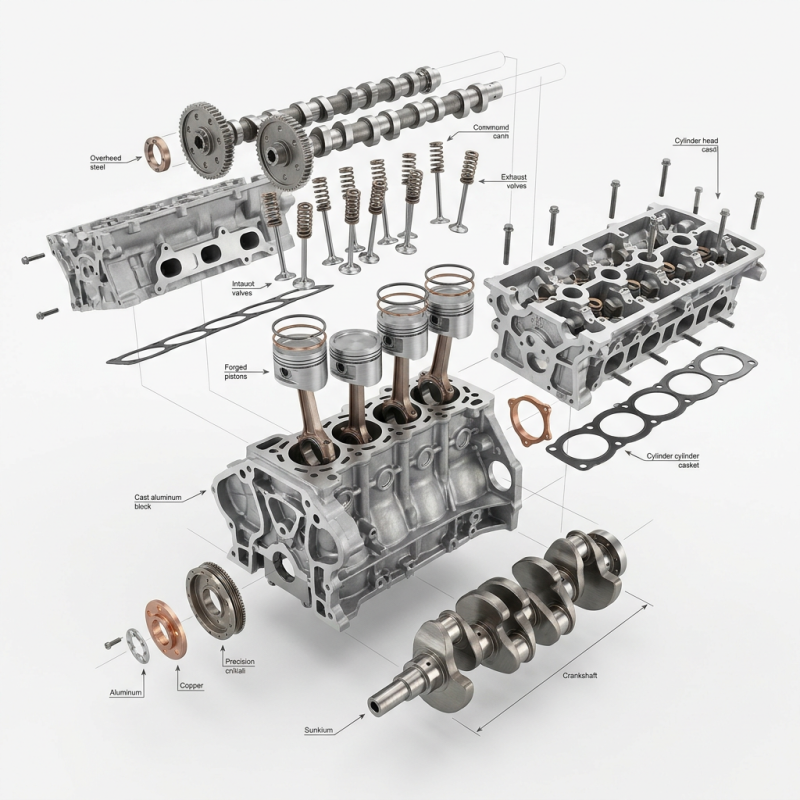
In terms of reciprocating inertial forces and balancing mechanisms, the reciprocating motion of the piston and connecting rod generates first- and second-order inertial forces along the cylinder axis. The degree to which these forces are eliminated directly determines the engine’s inherent vibration level. In an inline four-cylinder diesel engine, the symmetrical movement of the four pistons allows the first-order inertial forces to be completely canceled out. However, the second-order inertial forces—high-frequency components fluctuating at twice the crankshaft speed—cannot be naturally balanced. This necessitates the use of dual balance shafts rotating in opposite directions at twice the crankshaft speed to generate a counteracting torque. In contrast, an inline six-cylinder engine, due to the unique phase distribution of its piston movement, structurally balances its second-order inertial forces, requiring no additional balancing device. This is the mechanical basis for the superior smoothness of six-cylinder engines compared to four-cylinder engines. For V-type diesel engines, their balance characteristics are determined by the angle between the two cylinder banks and the crankshaft arrangement. A 90-degree V-type architecture with a flat crankshaft can achieve complete balance of the first-order inertial forces, while a 60-degree V-type requires a more complex crankshaft counterweight design. Any loss of counterweight or phase deviation caused by overhauling and reassembly will disrupt the factory-designed balance system, causing severe resonance amplification in the engine’s high-speed range.
Torsional vibration analysis of the crankshaft system is another crucial pillar of diesel engine dynamics. Its core lies in identifying the resonant relationship between the elastic system comprised of the crankshaft, flywheel, and damper, and the periodic bursts of torque excitation. The torque experienced by the crankshaft in each cycle is not constant but exhibits periodic pulsations with the alternation of the power strokes of each cylinder. When the pulsation frequency approaches the natural torsional frequency of the crankshaft system, torsional resonance occurs in the shaft segment, causing significant angular displacement fluctuations. The flywheel’s rotational inertia provides the system with the fundamental inertia to stabilize speed fluctuations, while the crankshaft damper dissipates the resonant energy into heat through the relative motion of the rubber elastic element and the inertial ring, keeping the amplitude within a safe range. In engineering, Campbell’s diagrams are used to plot the excitation frequencies and the system’s natural frequencies on a speed coordinate system to identify dangerous speed ranges and guide damper adjustment. For multi-cylinder, high-power diesel engines, this analysis directly determines the crankshaft fillet rolling process grade and the connecting rod bolt tightening specifications.
At the overall engine level, the dynamic design of the engine mount system determines the path and attenuation of vibrations transmitted from the powertrain to the chassis. Elastic mounts, by selecting appropriate stiffness and damping, ensure that the rigid body modal frequencies of the powertrain avoid the engine’s primary excitation frequencies, thus achieving effective vibration isolation in the idle and normal operating speed ranges. Diesel engines, due to their high combustion pressure and large torque fluctuations, experience more intense reaction torques on their mount systems. If the mounts age and fail, engine vibrations will be directly transmitted to the cab and precision accessories, resulting in decreased operating comfort and electronic component malfunctions. Understanding these dynamic mechanisms helps maintenance personnel accurately pinpoint the mechanical root cause of faults beyond the surface of vibration and noise, and provides a scientific basis for dynamic balancing acceptance after overhauls.
jianming machinery