


Volvo D7E engine, a medium-to-large displacement inline six-cylinder industrial diesel engine platform.

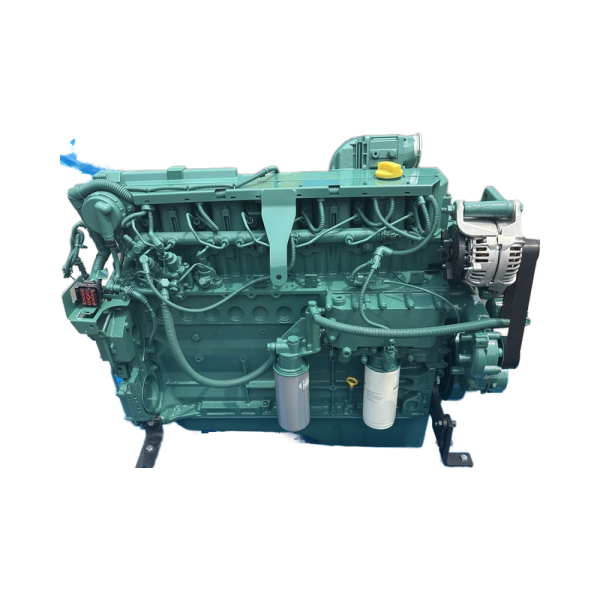
The Volvo Group’s D7E is a mid-to-large displacement inline six-cylinder industrial diesel engine platform and one of the core models in Volvo’s construction machinery powertrain system. This engine is primarily used in medium to large-scale construction equipment, such as wheel loaders, excavators, and some mining equipment. The D7E’s design goal is not simply to pursue high power output, but rather to achieve stable power, reliable structure, and long-term durability under complex engineering conditions. For construction machinery, the engine not only needs to provide sufficient power but must also maintain stable performance under prolonged high-load operation; therefore, structural strength, torque reserve, and thermal management capabilities are key design indicators.
Structurally, the D7E adopts an inline six-cylinder, water-cooled diesel engine layout, equipped with a turbocharger and intercooler system. The six-cylinder structure has significant advantages in mechanical balance, effectively reducing vibration and noise levels, allowing the entire machine to maintain stable operation under high load conditions. The water-cooling system removes the heat generated by combustion through a stable cooling cycle, ensuring that the cylinder temperature is controlled within a reasonable range. The turbocharging system increases the oxygen content in the cylinders by compressing intake air, resulting in more complete fuel combustion and higher power output under the same displacement conditions. The addition of an intercooler further reduces intake air temperature, increases air density, improves combustion efficiency, and also reduces thermal stress on the engine under high loads.
In terms of power characteristics, the D7E’s engineering design prioritizes torque output in the low-speed range. Construction machinery operates at low to medium speeds for most of its work, such as loading, bulldozing, or excavation, requiring the engine to provide stable and continuous power at lower speeds. Higher torque reserves allow the equipment to maintain a stable speed even with sudden increases in load, reducing power loss and avoiding mechanical wear caused by frequent speed increases. For the hydraulic system, stable torque output also ensures smoother hydraulic pump operation, improving overall machine maneuverability and construction efficiency.
The combustion system is a crucial component affecting engine efficiency and emissions. The D7E optimizes the combustion chamber structure and fuel injection system to create a more homogeneous air-fuel mixture in the cylinders, achieving a more complete combustion process. Improved combustion efficiency not only reduces fuel consumption but also decreases particulate emissions from incomplete combustion. By precisely controlling the fuel injection process, the engine maintains stable combustion under varying loads and speeds, resulting in smoother power output and improved overall fuel economy.
The thermal management system plays a crucial role in construction machinery engines. Since equipment typically operates continuously for extended periods, significant heat accumulates inside the engine. Insufficient heat dissipation can lead to elevated oil temperatures, excessive thermal expansion of components, and even material fatigue. The D7E’s design optimizes the cooling water channel structure and enhances the efficiency of the cooling system, allowing the coolant to more evenly dissipate heat from the cylinder block and cylinder head. Simultaneously, the oil cooling system is specially designed to ensure the lubricating oil maintains a stable viscosity under high load conditions, thus preserving excellent lubrication. These measures collectively ensure stable engine operation under high ambient temperatures or heavy loads.
Structural durability is a core indicator in the design of construction equipment power systems. The D7E employs a high-strength cast iron cylinder block structure and is equipped with a reinforced crankshaft and connecting rod system, enabling the engine to withstand continuous high torque output. The cylinder block structure boasts high rigidity, reducing deformation during high-load operation and ensuring cylinder sealing and combustion efficiency. The crankshaft system is reinforced to maintain excellent structural stability during high torque transmission. This design philosophy prioritizes long-term durability over extreme lightweighting, resulting in higher reliability in heavy-duty applications such as mining and construction.
In practical applications, the D7E engine is widely used in Volvo’s medium to large-sized construction machinery. This equipment typically operates continuously in complex environments, such as high-dust construction sites, high-temperature regions, and prolonged heavy-load conditions. The engine not only needs to provide stable power but also possesses high environmental adaptability. The D7E was designed with these application requirements in mind, utilizing a reinforced structure and optimized thermal management system to ensure a long service life even in harsh environments.
In summary, the Volvo Construction Equipment D7E is a six-cylinder industrial diesel engine with stable power output, strong torque reserves, and heavy-duty durability as its core advantages. Its technical approach emphasizes engineering reliability and long-term operational stability, and it has been extensively validated in practical applications within the medium to large-sized construction machinery sector. For equipment that needs to operate continuously under complex conditions, this durability-oriented power platform can effectively improve the overall working efficiency and reduce maintenance risks during long-term use.

