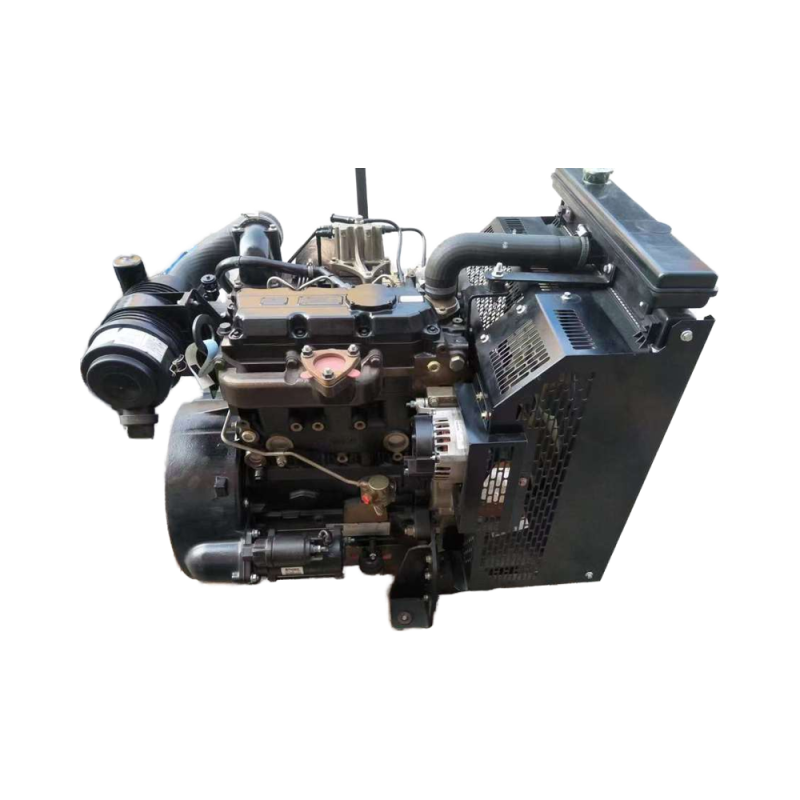
Perkins 1103A-33 Engine Technical Analysis


The Perkins 1103A-33, as the pure mechanical power benchmark in the 1100 series, is designed with the core philosophy of “low-speed resilience brought by a large single-cylinder displacement.” As a 3.3-liter naturally aspirated three-cylinder engine, it breaks the traditional four-cylinder engine’s monopoly in this displacement range, distributing the total displacement to only three cylinders, resulting in an astonishing 1.1 liters per cylinder. From a thermodynamic perspective, a larger single-cylinder volume means that under the same combustion pressure, the total thrust acting on the piston crown is greater. Combined with its long-stroke crankshaft design, this engine can generate nearly 200 Nm of peak torque at around 1400 RPM. This physical characteristic gives it exceptional “non-stalling” resilience when dealing with sudden loads from agricultural machinery or generator sets. Because it completely abandons the complex electronic control unit (ECU) and turbocharger, the energy flow chain of the 1103A-33 is extremely short and direct: ambient air is passively drawn in by the negative pressure generated by the piston’s downward movement, while fuel is centrifugally metered according to engine speed by a highly reliable mechanical rotary pump (such as the Delphi DP series). This purely mechanical feedback mechanism, while compromising on emission limits, gives it near-unbeatable survivability in remote mining areas or high-sulfur fuel environments.
A deeper analysis of the 1103A-33’s failure logic reveals that its reliability is highly dependent on the physical balance of “airflow quality and mechanical synchronization.” Since this engine is naturally aspirated, all power sources within the cylinders depend on the passive filling efficiency driven by atmospheric pressure. This means that even a minor blockage in the air filter can lead to an overly rich mixture, triggering a chain reaction of black smoke in the exhaust and carbon buildup inside the cylinders. In the mechanical balance dimension of a three-cylinder engine, due to the second-order unbalanced torque generated by piston movement, the crankshaft and flywheel experience more complex torsional vibrations than in a four-cylinder engine. To mitigate this physical defect, Perkins employs a high-strength forged crankshaft and an optimized gear drive chamber design. Micron-level wear on the timing gears in the gear chamber can cause injection timing drift, resulting in a phase misalignment of the fuel during the compression stroke. This misalignment, under high temperature and pressure, translates into severe mechanical shock (knocking), directly threatening the integrity of the lubricating oil film on the large main bearings. Therefore, for this three-cylinder engine, maintaining a precise valve clearance of 0.20mm is not only for smooth operation but also to ensure that the entire mechanical transmission chain maintains strict phase synchronization under thermal expansion.
From a system integration perspective, the 1103A-33’s thermal management system is its last line of defense for long-term operation. Because it only has three cylinders, the heat load distribution in the cylinder head is relatively concentrated, especially with physical differences in the heat exchange environment between the middle cylinder and the two outer cylinders. Perkins engineers optimized the cross-flow cylinder head design, completely separating the intake and exhaust passages on opposite sides. This utilizes fluid dynamics principles to guide forced convection of the coolant in high-temperature areas such as the valve seats. In practical industrial applications, the most common failures often stem from the “chemical thermal resistance” of the cooling system—that is, the reduced heat transfer efficiency caused by coolant buildup. Once the heat flux on the material surface cannot dissipate in time, the cylinder head gasket is highly susceptible to thermal fatigue failure under the physical pressure generated by the extremely high compression ratio (19.2:1), leading to oil-water mixing. Understanding this failure chain reveals that for the 1103A-33, preventative maintenance is not just about replacing the filter; it’s about continuous monitoring of three key physical variables: intake resistance, fuel injection timing, and coolant chemical properties. This ensures that this structurally simple engine maintains linear and stable energy output over a period exceeding 10,000 hours of operation.
jianming machiner