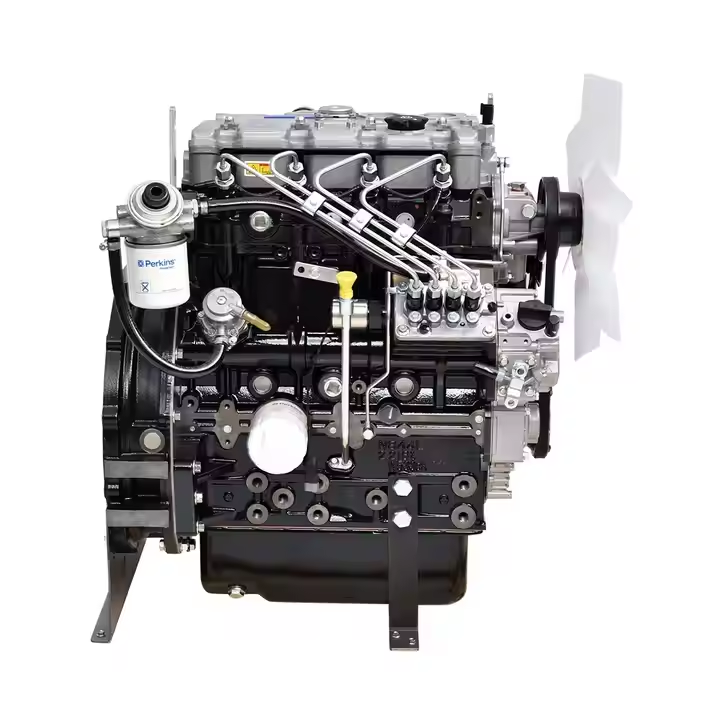
Perkins 404D-22 Engine Analysis


The Perkins 404D-22 is a 2.216-liter inline four-cylinder naturally aspirated diesel engine designed for exceptional smoothness through balanced power pulses from all four cylinders. This engine delivers a stable net power output of approximately 37.3 kW (50 hp) at its rated speed of 3000 RPM and a peak torque of 143 Nm at 1800 RPM. Its physical architecture, featuring an 84mm bore and a 100mm long stroke, provides excellent transient load response in medium-duty skid steer loaders, excavators, and generator sets exceeding 20kVA. Because the four-cylinder engine generates power every 180 degrees of crankshaft rotation, this close energy superposition significantly reduces torsional vibrations from mechanical reciprocating motion, providing a robust power foundation for driving precision hydraulic systems with stringent NVH (noise, vibration, and harshness) requirements. In terms of combustion technology, the 404D-22 features deeply optimized hydrodynamics of its indirect injection (IDI) system. The spherical vortex chamber within the cylinder head induces extremely high-speed cyclones at the end of the compression stroke, which, combined with the precise fuel injection from a mechanically operated piston pump, achieves highly efficient two-stage combustion. This pre-combustion chamber design not only reduces the pressure rise rate during combustion, thus suppressing the typical harsh knocking sound of diesel engines, but also gives the engine a very high tolerance for fuel quality. Its fuel distribution system relies entirely on mechanical compensation logic, with the injection start point physically locked by a static advance angle adjustment shim at the bottom of the pump body. In actual maintenance procedures, this design requires technicians to possess precise tolerance control capabilities; any shim error at the level of 0.05mm will directly interfere with the phase alignment of the thermodynamic cycle, affecting exhaust purity and power continuity under high loads.
For reliability in long-term operation, the 404D-22’s cylinder block adopts a high-rigidity integral cast iron structure, combined with a cross-flow cylinder head layout to optimize scavenging efficiency. Its thermal management system is specifically enhanced to improve cooling circulation in the pre-combustion chamber insert and valve bridge areas to cope with the localized high heat flow impacts unique to the IDI architecture. During deep overhauls or periodic maintenance, the tightening of cylinder head bolts must strictly adhere to a sequential standard of “torque + angle,” meaning an initial torque preload followed by two precise 90-degree turns to ensure uniform stress on the cylinder head gasket and prevent heat-induced deformation of the cylinder block. Simultaneously, maintenance personnel should regularly monitor valve deflection and maintain the chemical inertness of the coolant to prevent scale buildup in the water passages. This extreme demand for physical parameters is the engineering baseline that ensures this 2.2-liter engine maintains an ultra-long maintenance interval of 500 hours and a total lifespan of tens of thousands of hours under various extreme industrial environments.